
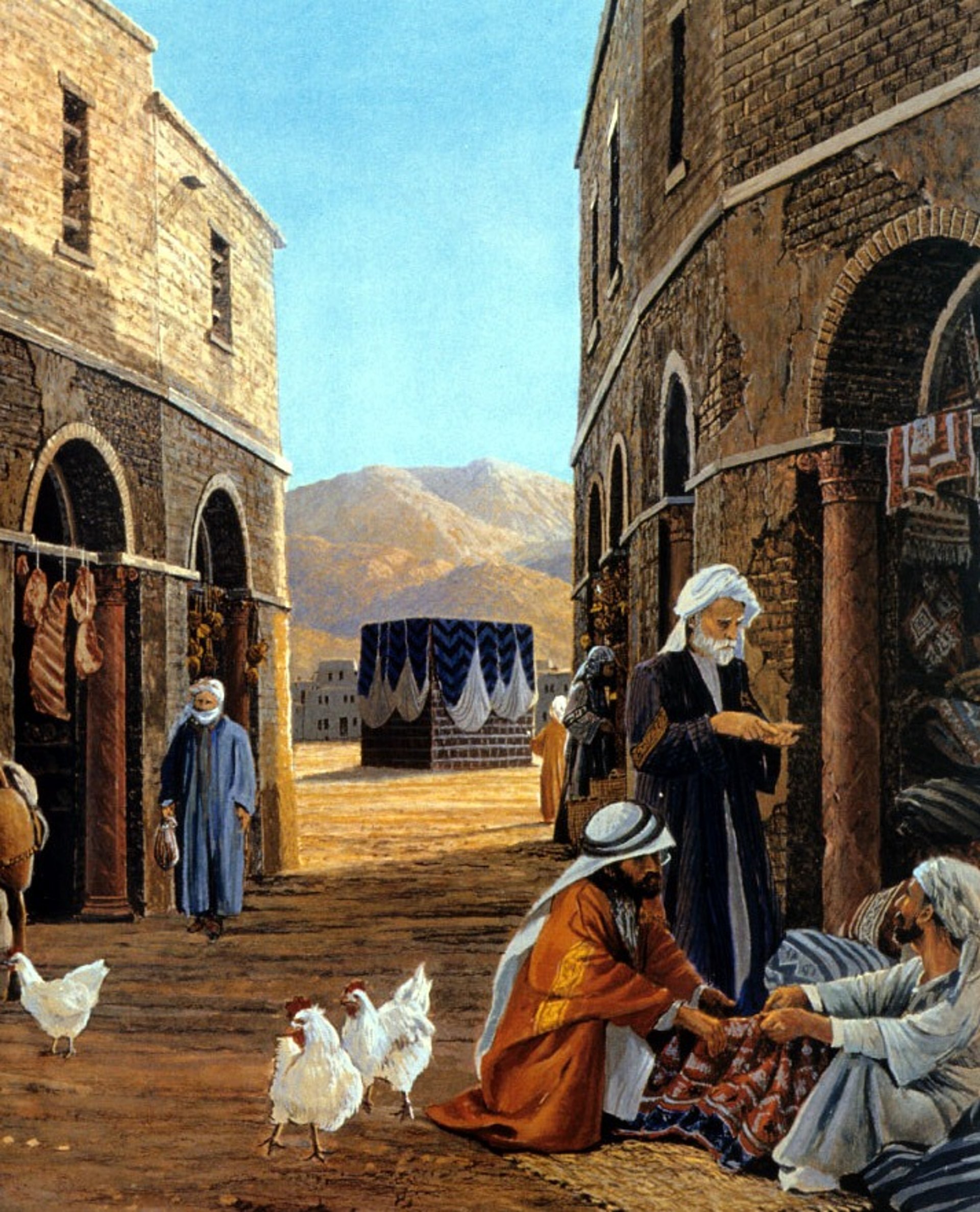
The Early Resistance to the Spread of Islam
The light of divine guidance shone upon the Arabian Peninsula at the start of the seventh century CE with the revelation being “a conclusive proof” from the Lord and “a clear light” (The Qur'an, an-Nisaa: 174). It evolved in a society which was driven by personal desires affecting morals, culminating into negligent character harbouring vices, misled by false tribal pride leading to decade-long profligate wars, and laden with rampant idolatry, disbelief of the Creator and the Last day, unjust socio-economic system blinded by materialistic objectives, superstitions, and adultery. In contrast, the divine creed of Islam proposed a monotheistic ideology and a just socio-economical system. It infused a sense of responsibility and answerability before the Lord, putting reins on the unrestrained passions.
The submission to Islamic principles implied abandoning much of the established norms and, consequently, called for resistance from the staunch pagans to an extreme extend as mentioned below:
1. Verbal slur and mockery:
Initially, the pagans took to admonitions, insults and vague counter-arguments. The first opposition came from within the Prophet’s (Peace be upon him) kinsfolk when his uncle, Abu Lahab, rebuked him and denied any support. This was followed by countless disdainful remarks at the Prophet (Peace be upon him) and the Muslims, especially from the weak social stature, haranguing them as “rulers of the world”. Muslims would be laughed at, made fun of and insulted for their ‘foolishness’ to adopt a new faith as noted in the Qur’an (al-Mutafififin:30-32). They would dispel the crowd to whom the Prophet (Peace be upon him) would start addressing by ridiculing the message of the Qur’an, calling the Prophet (Peace be upon him) a liar and a madman, and causing hullabaloo as mentioned in the Qur’an (Fussilat:26). A polytheist namely Nadir bin Harith went as far as to Hira and Syria to gather the ancient tales and narrate them just to divert the people away from the Prophet’s (Peace be upon him) sermon.
2. Machinations:
To alleviate the effect of Islamic campaign, the pagans attempted to discredit its source by various means. As an example, their chieftains, with the consultation of Al-waleed ibn Mugheerah, deliberated to debar the pilgrims from the divine campaign by labelling the Prophet (Peace be upon him) as magician “alienating” family ties. As soon as Islam found a safe haven in Abyssinia under the rulership of a just ruler, An-Najaashee, the pagans deployed two envoys, ‘Amr ibn al-‘Aas and ‘Abdullah ibn Abee Rabee’ah, with “gifts from the merchandise” intending to incline the ruler to accept their demand of extraditing Muslims back to Makkah. The pagans would promptly approach the revered, noble and wise visiting people who entered the boundaries of Makkah and start slandering the Prophet (Peace be upon him); one such example being that of Al-Husain, father of ‘Imraan bin Husain.
3. Negotiations:
The support of Abu Talib for the Prophet (Peace be upon him) prevented the pagans, to a large scale, to physically hamper the growth of Islam. However, being their co-religionist, they would coerce him, in the name of ancestral pride, to convince the Prophet (Peace be upon him) to end his campaign against their religion. After repeated unsuccessful attempts, their desperation led them to a very ridiculous proposal to Abu Talib in which they demanded him to hand over the Prophet (Peace be upon him) in exchange for ‘Umaarah ibn al-Waleed ibn al-Mugheerah “who was a young, handsome and of noble lineage”. Met with failure, they even tried to approach the Prophet (Peace be upon him) directly to lure him towards the materialistic riches in exchange for ending his mission. Similarly, ‘Utbah ibn Rabee’ah approached the Prophet (Peace be upon him) offering him wealth, power and women. Yet, despite of successive refusals, they sent one more delegation consisting of al-Aswad ibn ‘Abdul-Mutallib, al-Waleed ibn al-Mugheerah, Ummayah ibn Khalaf and al-‘Aas ibn Waail to negotiate with the Prophet (Peace be upon him) to find a leeway between his divine monotheistic call and their unchaste man-made idolatry, an offer rejected by the Qur’an (al-Kafirun). Another deliberation was sent to convince the Prophet (Peace be upon him) to, at least, remove the verses insulting their deities.
4. Persecutions:
Despite the resolute support from Abu Talib, the pagans did not falter in inflicting harm on the Prophet (Peace be upon him) and other Muslims. As-Sallaabee, in his book, The Noble Life of the Prophet, mentions Abu Jahl’s attempt to tread on Prophet’s (Peace be upon him) neck while he was in prayer, ‘Uqbah ibn Abee Mu’aid’s attempt to place the entrails of a camel on his shoulders while he was in prostration, their strangling the Prophet (Peace be upon him) with his garment, Umm Jameel’s (wife of Abu Lahab) spreading the thorns along his path and impurity in front of his house and many such occurrences. The Muslims, especially from the lower classes were also badly persecuted. As-Sallaabee narrates the horrific tortures of Bilaal, ‘Ammar ibn Yaasir and his family, Khabaab ibn al-Arat, ‘Abdullah ibn Mas’ood and others (May Allah be please with them). Most of them were taken out to the heat of the desert and crushed under blazing rocks, beaten, struck with hot iron and likewise.
5. Social Embargo in the seventh year of Prophethood:
The pagan infliction of the Muslims on an individual level seemed futile and, instead, inadvertently led to further spread of Islam. Their inability to quell the ongoing march led them to launch an attack in a new dimension in the seventh year of Prophethood which was not only limited to the Muslims but to all those who sided with them. As-Sallaabee mentions,
“The leaders of the Quraish issued an edict, prohibiting members of the Quraish from engaging in any dealings whatsoever with the Prophet’s companions, but also with non-Muslim members of the Banu Hashim clan – except Abu Lahab (and maybe a few others like him), who sided with the polytheists.”
The embargo applied to social interactions, economic exchanges, and other dealings and would be applicable until the Prophet (Peace be upon him) was handed over to them. It was hung in the form of a declaration in Ka’bah for emphasis. It lasted for three years which were full of misery for the Muslims as well as the members of Banu Mutallib clan.
The pagans left no stone unturned in their work against the spread of Islam. Conclusively, it is also worthy to note that no efforts from the pagans were sturdy enough to keep Islam from not only taking over the Arabian Peninsula but enlightening all the dark corners of the world.
Published by: Rising Kashmir
Date: 20th December 2018